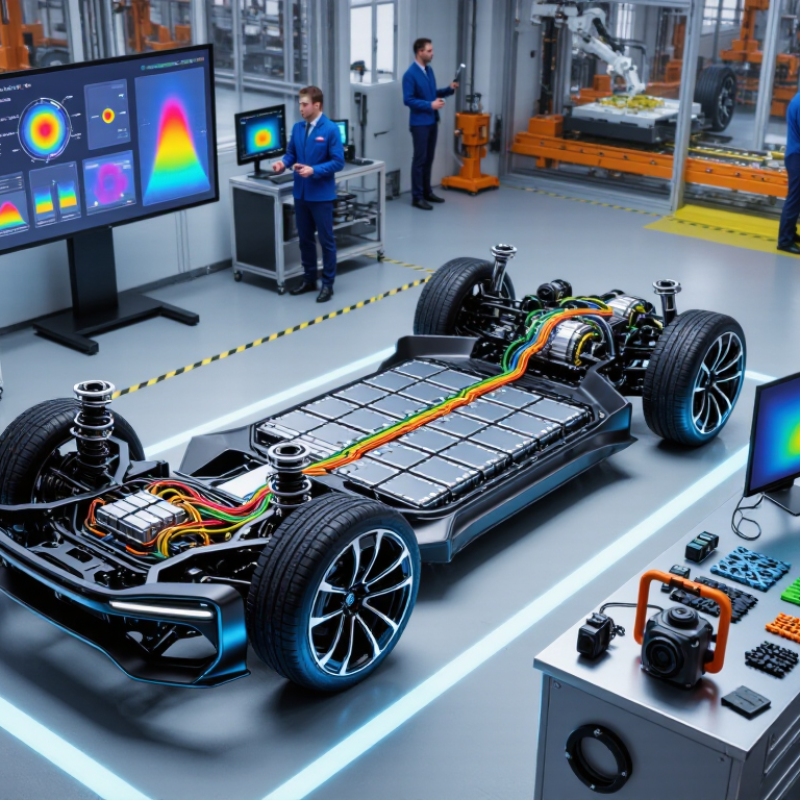
| Battery-electric vehicle expansion |
Share of global new-car sales |
More than 20% of new cars sold globally in 2024 were electric. |
Component portfolios are shifting from internal-combustion powertrain parts toward high-voltage energy storage, power electronics, thermal systems and electric drive units. |
Battery packs, inverters, onboard chargers, DC-DC converters, electric motors and battery-management systems |
International Energy Agency, Global EV Outlook 2025 |
| Battery cost optimization |
Average lithium-ion battery-pack price |
The global average battery-pack price reached approximately US$115 per kWh in 2024. |
Lower pack costs support larger energy capacities, while increasing attention is placed on cell-to-pack integration, structural packaging, thermal propagation control and serviceability. |
Cells, modules, pack enclosures, busbars, cooling plates, sensors and battery-management electronics |
BloombergNEF, Lithium-Ion Battery Pack Prices 2024 |
| High-voltage vehicle architectures |
Traction-system voltage classes |
Passenger-vehicle traction systems commonly use approximately 400 V or 800 V nominal architectures. |
Higher voltage enables lower current for the same power level, helping reduce cable cross-section, resistive losses and charging-system mass, while increasing insulation and safety requirements. |
High-voltage cables, connectors, contactors, fuses, inverters, compressors and charging modules |
IEC 60664-1, ISO 6469 series and established automotive electrical-system design practice |
| Faster DC charging |
Charging-power capability |
Public high-power DC charging systems can deliver up to approximately 350 kW under suitable vehicle, charger and grid conditions. |
Charging performance requires improved thermal management, higher-current terminals, coordinated battery controls and robust protection against electrical and thermal stress. |
Charging inlets, high-current terminals, battery cooling systems, contactors, current sensors and charging-control software |
Combined Charging System specifications and public charging infrastructure standards, 2024–2025 |
| 48 V auxiliary electrification |
Electrical power delivery at equal output power |
At the same power level, a 48 V system carries one-quarter of the current required by a 12 V system, before accounting for conversion losses. |
Lower current enables more efficient electrification of actuators and auxiliaries while reducing conductor losses and allowing smaller wiring for selected loads. |
Electric pumps, active chassis systems, thermal actuators, compressors, belt-starter generators and DC-DC converters |
Electrical relationship P = V × I; 12 V and 48 V vehicle-system engineering practice |
| Zonal electrical architectures |
Vehicle wiring and control distribution |
Zonal architectures consolidate distributed electronic control functions into regional nodes connected to central computing platforms. |
Shorter wiring paths, reduced harness mass, simplified assembly and software-defined feature deployment become major design objectives. |
Zone controllers, power-distribution units, wiring harnesses, gateways, sensors and actuators |
Automotive Systems Engineering architecture practice; ISO 26262 and ISO/SAE 21434 design requirements |
| Software-defined vehicle platforms |
Cybersecurity and software-update compliance |
UNECE Regulations R155 and R156 apply to cybersecurity management and software-update management for relevant vehicle approvals in the European market from July 2024. |
Components increasingly require secure boot, authenticated diagnostics, update capability, event logging and lifecycle cybersecurity controls. |
Electronic control units, gateways, telematics modules, domain controllers and diagnostic interfaces |
United Nations Economic Commission for Europe, UNECE R155 and R156 |
| Automotive Ethernet networking |
In-vehicle data bandwidth |
Automotive Ethernet standards support 100 Mb/s, 1 Gb/s and multi-gigabit communication for different vehicle-network requirements. |
Higher bandwidth supports centralized computing, advanced driver-assistance functions, high-resolution sensors and faster over-the-air data transfer. |
Network switches, gateways, zonal controllers, cameras, radar interfaces and central computing units |
IEEE 802.3 automotive Ethernet standards and related OPEN Alliance specifications |
| Wide-bandgap power electronics |
Power-semiconductor material technology |
Silicon-carbide and gallium-nitride devices can operate at higher switching frequencies and temperatures than conventional silicon devices in suitable applications. |
Higher efficiency and smaller passive components can reduce inverter and charger size, although material cost, packaging and thermal reliability remain important trade-offs. |
Traction inverters, onboard chargers, DC-DC converters and fast-charging power modules |
International Energy Agency and IEEE power-electronics research literature |
| Lightweight multi-material structures |
Material density comparison |
Aluminum has a density of approximately 2.70 g/cm³, compared with approximately 7.85 g/cm³ for conventional steel. |
Multi-material body and battery structures can reduce mass, but joining, corrosion protection, crash performance and recycling compatibility must be engineered together. |
Battery trays, body structures, suspension components, crash-management systems and thermal housings |
ASM International material-property data and automotive structural-design references |
| Vehicle-efficiency regulation |
European fleet CO₂ target for new passenger cars |
The European Union fleet-wide target for 2025–2029 is 93.6 g CO₂/km under the applicable regulatory test framework. |
Suppliers are prioritizing lower-loss bearings, efficient electric auxiliaries, aerodynamic systems, low-rolling-resistance solutions and lightweight components. |
Powertrain components, thermal systems, wheels, tires, body panels, active aerodynamics and HVAC systems |
European Union Regulation (EU) 2019/631, amended through 2023 |
 Mayumi Auto